Subscribe!
Charitable Organizations

Charitable Organizations
Qualified charitable organizations include nonprofit groups that are religious, charitable, educational, scientific, or literary in purpose, or that work to prevent cruelty to children or animals.
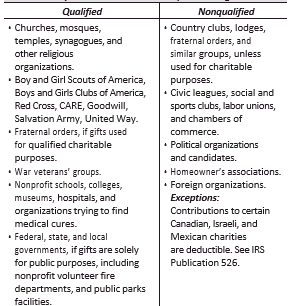
Online search tool. The IRS provides a way to search for qualified charitable organizations online at www.irs.gov/charities- non-profits/search-for-tax-exempt-organizations.
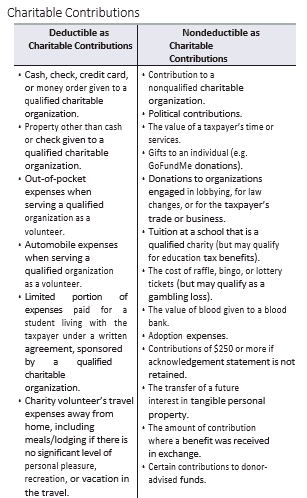
Contributions That Benefit You If you receive a benefit in exchange for a charitable contribution, the deduction is reduced by the value of the benefit received .
Athletic tickets. No deduction is allowed for amounts paid to (or for the benefit of) a college or university in exchange for athletic event tickets or seating rights.
Membership fees or dues as a donation. Membership dues or fees paid to qualified charitable organization, mi- nus the value of any membership benefits, are deductible. If the annual fee is $75 or less, certain membership benefits are disregarded, even if you pay more than $75 annually. Examples of disregarded benefits include:
• Free or discounted parking or admission to events or facilities.
• Preferred access to, or discounts for organization goods or services.
• Admission to member-only events for which the admission cost is a token amount or $13.60 or less.
Charitable benefit event ticket. The deduction equals the ticket price, minus the value of the right to attend the event. This is true even if you did not actually attend the event. However, if the ticket is returned to the qualified charity for resale, the entire cost of the ticket is deductible.
60% adjusted gross income (AGI) limit. Cash contributions to public charities and certain other organizations are limited to 60% of AGI. The 60% limit does not apply to noncash charitable contributions, which are limited to 50% of AGI.
Example: Rachel made a cash donation of $8,000 to her favorite public charity. This was her only charitable contribution for the year. Rachel’s AGI is $10,000. Because of the 60% AGI limitation, she is only allowed a deduction of $6,000. The remaining $2,000 is carried forward for up to five years.
30% AGI limit. The 30% AGI limit applies to:
• Donations to organizations that are not public charities, such as veterans’ organizations, fraternal societies, non- profit cemeteries, and certain private foundations.
• Donation of property that is used by a charity, other than capital gain property donated to a non-public charity.
• Cash contributions for the use of (held in trust) a public charity instead of to the charity.
• Deduction for student living expenses.
• Certain capital gain property contributions to public charities. However, you can elect to apply the 50% AGI limit.
20% limit. The 20% AGI limit applies to noncash contributions of capital gain property to non-public charities, or for the use of, any qualified organization.
State or local credit for charitable contribution limit. The federal charitable contribution deduction is limited to the extent you receive or expect to receive a corresponding state or local tax credit for that contribution.
Example: In 2025, Andy makes a charitable contribution of
$1,000 to the state of New York receiving a state tax credit of 70% of the amount contributed ($700). Andy’s federal charitable contribution deduction may not exceed $300.
Donating a Vehicle
Written Acknowledgement
Obtain written acknowledgement from the organization, which includes details on the use or disposition of the vehicle by the donee organization. A copy of the written acknowledgement must be attached to the tax return.
Deduction More Than $500
A vehicle donation with a claimed fair market value (FMV) more than $500 is limited.
1) If the organization sells the donated vehicle without a significant intervening use of or material improvement by the donee organization, then the deduction is limited to the gross proceeds received from the sale.
2) If the organization sells the donated vehicle after a significant intervening use of or material improvement to the vehicle, the deduction is limited to its FMV.
3) If the organization gives or sells the vehicle at well below FMV to a needy individual in line with the purpose of the charity to provide transportation to the poor, the deduction is limited to FMV.
Donation $500 or Less
A written acknowledgement is still required if the contribution is $250 or more. If the organization sells the vehicle without any significant intervening use of or material improvement for $500 or less, the deduction is equal to the lesser of $500, or FMV. FMV can be private sale price for a similar vehicle in a used vehicle pricing guide.
Example: Jack donates his car, worth $800, to a charity that sells it for $400 without any significant intervening use or material improvements. Jack can deduct $500 as a charitable contribution. Because his deduction is $250 or more, he still needs a written acknowledgement from the charity, but the acknowledgement is not required to be attached to his return.
Clothing or household items. No deduction is allowed for a charitable contribution of clothing or household items unless the clothing or household item is in good used condition or better. The IRS is authorized by regulation to deny a deduction for any contribution of clothing or a household item that has minimal monetary value, such as used socks and undergarments.
Planning Tip: Take a picture of all items donated. Keep the pictures for proof the items were in good or better condition at the time they were donated.
Substantiation Requirements for Charitable Contributions
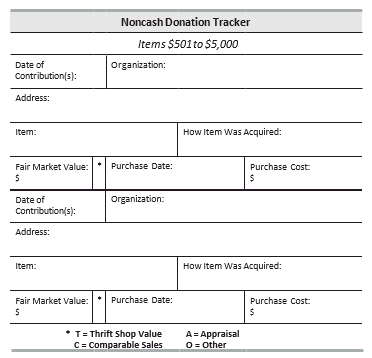
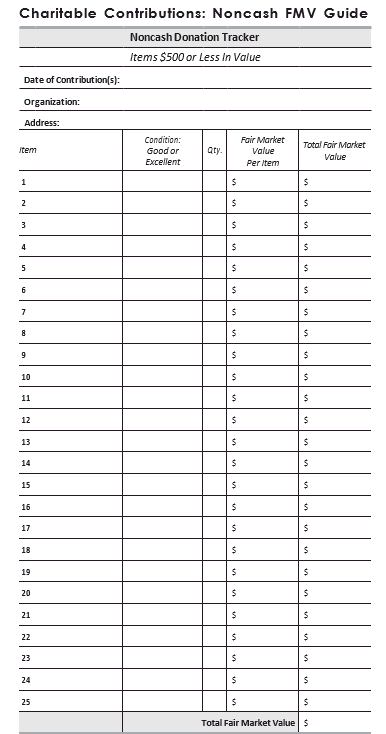
To help substantiate a deduction for the fair market value of used items donated to charity, make a list of each item donated on a separate sheet of paper along with the following information.
• Name and address of charity.
• Date item was donated to the charity.
• Description of each item donated.
• Fair market value of each item at the time it was donated (see the list on this page).
• Date each donated item was originally purchased or acquired.
• Cost or other basis of each item donated.